How to Find the Right Influencer for Your Brand in India
India's influencer market is racing toward ₹11,000 crore — yet most of that budget is wasted on the wrong creators. Here's how to choose the ones who actually convert, without burning a single rupee on reach you don't need.
By SocialCelebrity8 min readBrand StrategyJune 2026
India's influencer marketing industry is no longer a side experiment — it's a core growth channel, estimated at ₹3,000–3,500 crore in 2025 and projected to cross ₹11,000 crore by 2033. But here's what nobody says openly: most of that budget is wasted. Not because influencer marketing doesn't work — it works spectacularly when done right. The problem is the mismatch. Brands chase follower counts, pick influencers by how big they look on a profile, and end up with beautiful content that reaches the wrong audience and drives zero sales.
THE REAL PROBLEM
Reach is not relevance
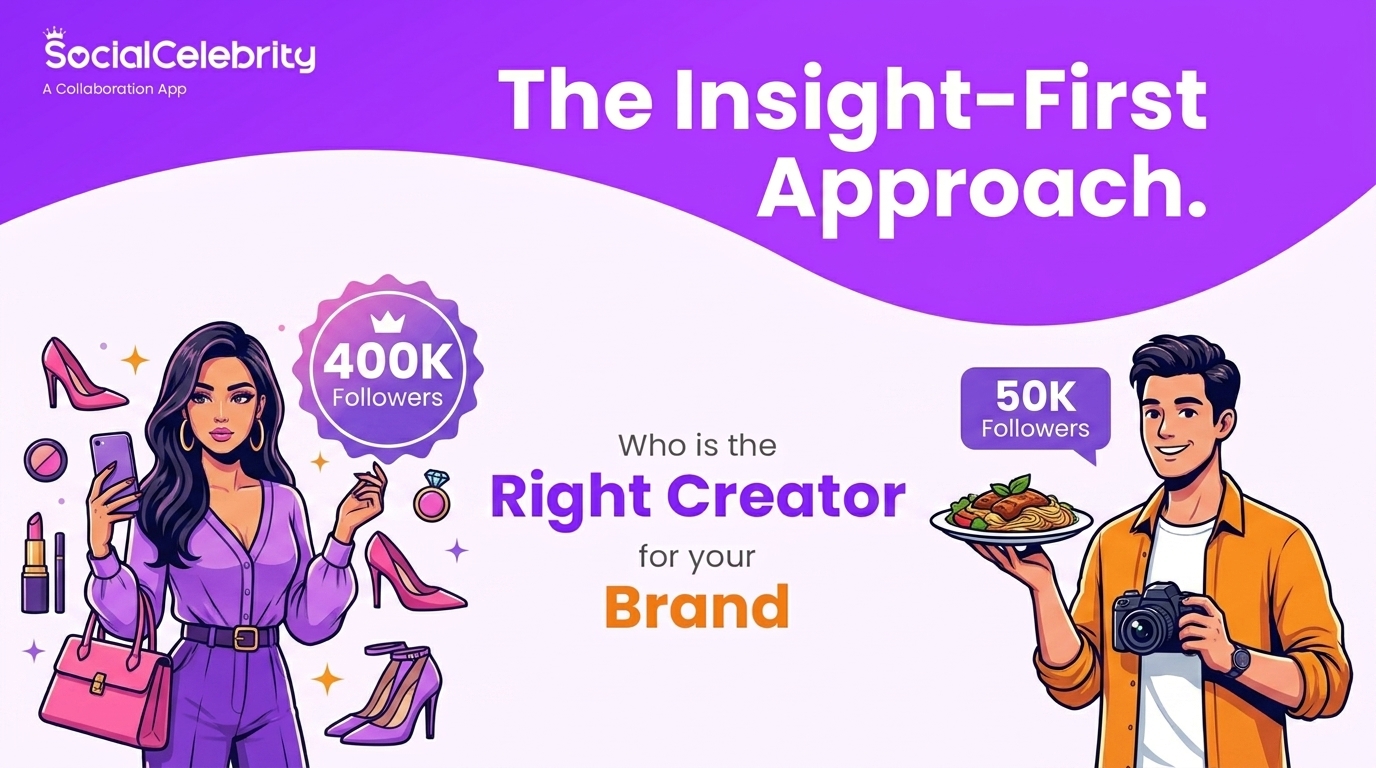
The most common mistake Indian brands make is confusing reach with relevance. A celebrity with 5 million followers might reach a massive audience — but if only 3% of them live in your city, care about your category, or are likely to buy, you've paid a premium to talk to people who were never going to buy anyway.
Meanwhile, a Pune food blogger with 28,000 followers whose audience is 80% local, food-obsessed, and aged 22–35 is worth five times the ROI for the right restaurant brand. The data backs this up: micro and nano influencers now drive over 60% of campaign ROI for D2C brands in India. The brands winning today stopped asking "how many followers?" and started asking "are these the right followers?"
The brands winning at influencer marketing in India aren't the ones with the biggest budgets — they're the ones with the sharpest systems.
01 · CHECK BEFORE YOU CHOOSE
Engagement Rate
The number that actually matters
Follower count is a vanity metric. Engagement rate tells you whether those followers are real people who actually care. If a 500K account gets 200 likes a post, something is wrong — the audience is fake, inactive, or purchased.
Tier
Followers
Good Engagement
Nano
Under 10K
5–10%
Micro
10K–100K
3–6%
Mid-tier
100K–500K
1.5–3%
Macro
500K–1M
0.8–1.5%
Celebrity
1M+
0.5–1%
Formula: (Total Likes + Comments) ÷ Total Followers × 100. Always calculate this before you commit.
02 · CHECK BEFORE YOU CHOOSE
Niche Relevance
Are they actually talking to your buyer?
An influencer's category needs to align with your product, not just their aesthetic — these are different things. A lifestyle influencer who posts travel, food, fashion and fitness might look visually aligned with your skincare brand, but their audience came for travel. A skincare creator with a tenth of the followers, whose comment section is full of "where can I buy this?", is your audience.
Ask one question: would their followers naturally be interested in my product, even without the sponsorship?
03 · CHECK BEFORE YOU CHOOSE
Audience Demographics
Location is everything for Indian brands
India is not one market. An influencer based in Mumbai with a Mumbai audience is irrelevant to a restaurant launching in Jaipur. A creator whose audience skews 18–21 may not convert for a premium product targeting 28–35 year-olds with purchasing power. Before any partnership, ask for:
• Audience city / state breakdown • Age group distribution • Gender split • Active hours
Red flag: most professional creators can share these from Instagram Insights or YouTube Analytics. If they can't or won't, walk away.
04 · CHECK BEFORE YOU CHOOSE
Content & Authenticity
Audiences can tell when it's read off a brief
Scroll back at least 3 months. Do sponsored posts feel natural, or does the ad copy land awkwardly? Do followers engage with branded content or only organic posts? Is production quality consistent? Have they promoted competitors recently? Authenticity in India's creator economy is currency — the creator who genuinely uses a product converts; the one reading off a brief doesn't.
05 · CHECK BEFORE YOU CHOOSE
Track Record
Has this creator delivered before?
Has the creator worked with similar brands? Can they share performance data — reach, saves, link clicks, story swipe-ups? Experienced creators deliver on time, follow guidelines, and communicate clearly. A first brand deal from a creator with no track record is a gamble — manageable for small budgets, risky for large ones.
STRATEGY
Which tier should you work with?
Nano (under 10K) — ideal for hyper-local campaigns, community brands and product trials. Their audience trusts them like a friend. High conversion, low cost.
Micro (10K–100K) — the sweet spot for most Indian D2C brands. Enough reach to matter, high enough engagement to convert, rates that fit real budgets. 60%+ of serious campaign ROI comes from here.
Mid-tier & macro (100K–1M) — strong for awareness and launches when you need reach fast. Pair them with performance tracking so you know who actually moved the needle.
Celebrity (1M+) — for aspirational positioning and national campaigns. They build brand recall, not purchase intent, at that scale.
Smart strategy mixes tiers: a macro for reach, micro for conversions, nano for community trust.
WATCH OUT
Fake Followers
More common than brands admit
Follower purchasing is cheap in India — 50,000 followers for a few thousand rupees. It looks impressive until you check engagement, audience quality or conversions. Look for:
• Sudden spikes in follower growth (visible on tools like Social Blade) • High follower count with disproportionately low comments • Generic one-word comments ("Nice!", "Great post!") from suspicious profiles • Engagement that disappears on non-sponsored posts
HOW TO WORK WITH THEM
Open campaigns vs. invite-only
Open campaigns let any eligible creator apply — powerful when you want volume and a wave of content across many audiences and styles. Invite-only campaigns give you control: you curate exactly who represents your brand, ideal for premium positioning or sensitive categories.
Neither is universally better. The smartest campaigns combine both — an invite-only core of 5–10 carefully chosen creators, supplemented by an open campaign that draws in a broader pool.
The takeaway
Finding the right influencer in India isn't complicated — but it does require discipline. Check engagement, not just followers. Prioritise niche relevance over aesthetics. Verify audience demographics, especially location. Vet content quality and track record. And mix creator tiers intelligently rather than betting everything on one big name.
The brands that crack influencer marketing in India over the next two years won't be the ones with the biggest budgets. They'll be the ones with the sharpest systems.